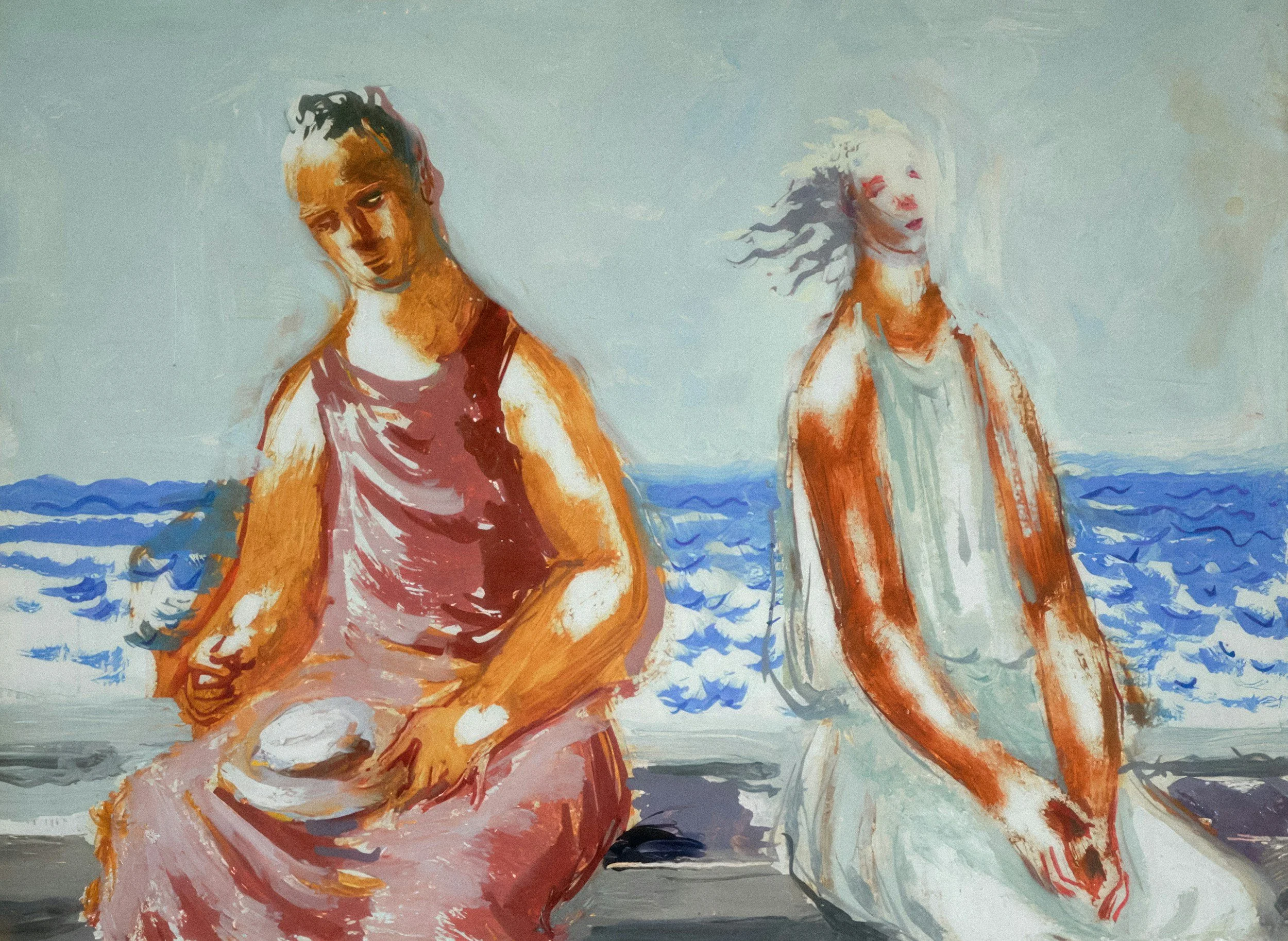
Art from the Europeana on Unsplash.
It is a truth generally acknowledged by Nnamdi and his wife that they could live happily ever after, if only their marriage could make sounds at night; so as Nnamdi returns home on this rainy evening, he hopes for a difference, prays silently in his heart that this night will be different; because this night is the farthest he can manage, and he is sure his wife would not even want to go any further into this dark lane of a marriage whose walls remain ever-constricting in many wondrous but stifling ways; ways that have upturned Nnamdi’s image of a blissful union, what would have been his wife’s source of pride in the gathering of her unmarried friends, one of whom Nnamdi has been in bed with to prove he wasn’t at fault—he hated having to prove anything, but at least he had to prove to himself—after which he had convinced his wife to pick a man of her choice and also prove her ‘innocence’; which the woman had to do because—although she enjoyed the small period of being with someone other than the soundless Nnamdi—she also wanted to save her marriage, their marriage, if only a proof was all it would cost; but she did not know (even though she later realized) that proof is not a solution; and despite the fact that her sounds of passion tore through the roof when she was in another man’s bed, despite the fact that with her friend, Nnamdi had claimed to make the weirdest exclamations of ecstasy, their acts of intimacy still retained an air of draining silence, rendering the whole minutes so mechanical, like a boring therapy session that two children have to sit through because they do not have a choice—and this is what makes theirs different: they are not choice-less, if they cannot live happily, then they could leave happily, and if anyone asked why their marriage ended, they would give one word for an answer: silence, but if the person is a close friend or a family member, they could say beyond a single word and tell the person that they tried all they could to make their union talk, to trigger it into lively speech and although the questioner would leave definitely confused by this answer, neither Nnamdi nor his wife would confess that each night before they climbed under the duvet, they prayed for God to put words into their lips, to let them moan if truly this union is approved by Him; until they relocated to the bedroom floor and abandoned the bed and the duvet which they believed sucked up their words; until they settled for the toilets, then the balcony, then their tiny box-like kitchen; until last week when they both agreed—neither Nnamdi nor his wife can remember who raised the topic first—that they should dissolve the marriage by the end of the new week and go their separate ways; which his wife admitted was going to be a difficult decision to make; which also, on Nnamdi’s part, spurred him into a more frantically desperate search for a solution; and now as he headed home in this drizzle to his wife with this bottle of liquid he bought from Dokta, it is his enthusiasm—more than his feet—that propels him: down to his street, to his gate, to his bedroom where he hugs his wife for a minute too long, to the bathroom where he barely cares to wash his body well, then back to the bedroom where he fills a cup with the liquid from Dokta’s bottle and downs it all before refilling the cup again for his wife, who swallows hers without hesitation, having been told by Nnamdi that it was a drug from Dokta to cure their issue of silence—and it did solve the problem of silence, after Nnamdi’s first set of rapid thrusts, a sound escaped his wife’s mouth, only that Nnamdi did not notice the strange caprine quality of it, even as it got louder and his wife began ‘bleating’ sounds; even as he himself rendered a heightened tenor to this goat-melody of theirs: their first music of pleasure since twenty-three months of being married; and with this unlikely melody they stirred the entire compound awake, their neighbours rushing to see what goats were crying in Nnamdi’s house; it is this memory that will haunt them even years after their divorce: all their neighbours gathered in front of their door, knocking and knocking until Nnamdi and his wife opened the door, only to find on the faces of their neighbours, a question they were ashamed to answer, a question which the neighbours themselves refused to believe the answer they got by looking at the sweating, shame-flushed couple, until one by one, each man returned to their own homes, leaving Nnamdi and his wife, who simply returned to bed and wrapped themselves around each other because they were all they had, at least until they divorced on Saturday.